For this 111 Navy® Chair, heritage brand Emeco collaborated with Coca-Cola to solve an environmental problem: upcycling consumer waste into a sustainable chair. The 111 chair is made from 111 plastic bottles, 65% recycled PET plastic and 35% glass fiber and pigment. Since its 2010 launch, the chair has diverted over 20 million bottles out…
For this 111 Navy® Chair, heritage brand Emeco collaborated with Coca-Cola to solve an environmental problem: upcycling consumer waste into a sustainable chair. The 111 chair is made from 111 plastic bottles, 65% recycled PET plastic and 35% glass fiber and pigment. Since its 2010 launch, the chair has diverted over 20 million bottles out…
For this 111 Navy® Chair, heritage brand Emeco collaborated with Coca-Cola to solve an environmental problem: upcycling consumer waste into a sustainable chair. The 111 chair is made from 111 plastic bottles, 65% recycled PET plastic and 35% glass fiber and pigment. Since its 2010 launch, the chair has diverted over 20 million bottles out…
The Emeco 1006 Navy® Chair is made through the company’s famous 77-step process. This process—which results in a one-piece, monolithic chair—involves soft, recycled aluminum that is hand-formed, welded, tempered and anodized for a durable finish. With no hardware fasteners and welds that grounded down, the chair is perfectly smooth with a flush appearance. Made for…
The Emeco 1006 Navy® Chair is made through the company’s famous 77-step process. This process—which results in a one-piece, monolithic chair—involves soft, recycled aluminum that is hand-formed, welded, tempered and anodized for a durable finish. With no hardware fasteners and welds that grounded down, the chair is perfectly smooth with a flush appearance. Made for…
Designed in 1960, this Steps Rug features an iconic mid-century textile design by Alexander Girard. The fabric is 100% cotton in a flatweave construction, manufactured by Maharam, a company founded in Chicago in 1902 by Russian immigrant Louis Maharam. Girard, who was born in New York City in 1907, is known for the fabrics he…
Select options
This product has multiple variants. The options may be chosen on the product page
Designed in 1960, this Steps Rug features an iconic mid-century textile design by Alexander Girard. The fabric is 100% cotton in a flatweave construction, manufactured by Maharam, a company founded in Chicago in 1902 by Russian immigrant Louis Maharam. Girard, who was born in New York City in 1907, is known for the fabrics he…
Select options
This product has multiple variants. The options may be chosen on the product page
Designed in 1960, this Steps Rug features an iconic mid-century textile design by Alexander Girard. The fabric is 100% cotton in a flatweave construction, manufactured by Maharam, a company founded in Chicago in 1902 by Russian immigrant Louis Maharam. Girard, who was born in New York City in 1907, is known for the fabrics he…
Select options
This product has multiple variants. The options may be chosen on the product page
“Developing a new chair for Vitra in the wake of a masterpiece like the Eames’ Lounge Chair was a unique challenge,” reflects Antonio Citterio. But, worthy of its iconic predecessor, Citterio’s premium leather chair cradles the sitter in deeply relaxing comfort, whether reading, enjoying conversation, or reclining. The concealed mechanism can be adjusted to any…
When he found a pile of scrap cardboard outside his office one day, Frank Gehry decided to experiment by laminating and shaping it with a hand saw and a pocket knife. The result: This sinuous side chair, part of Gehry’s Easy Edges line and a design included in MoMA’s collection. Reinforced by hardboard panels, the…
Born in Ethiopia and based in Virginia, designer Jomo Tariku conceived this Dogon Stool as a modern take on small geometric stools found in the African nation of Mali. Growing up in Ethiopia, Tariku was drawn to the eclectic art and furniture pieces that his father collected from all over Africa. Tariku developed his craft…
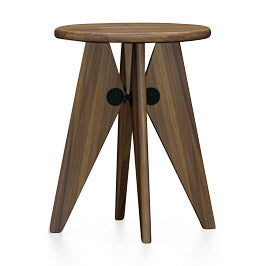
Designed for the Solvay Chemical company in 1941-42, Jean Prouvé’s tabouret prioritizes wood, as metals were scarce during the War. Despite these limitations, the streamlined design is infused with Prouvé’s timeless structural principles: The circular seat is supported by an architectonic array of fin-like legs, joined by black, powder-coated steel hardware. Available in natural oak,…
Designed for the Solvay Chemical company in 1941-42, Jean Prouvé’s tabouret prioritizes wood, as metals were scarce during the War. Despite these limitations, the streamlined design is infused with Prouvé’s timeless structural principles: The circular seat is supported by an architectonic array of fin-like legs, joined by black, powder-coated steel hardware. Available in natural oak,…
A sleek, statement-making table from a designer in MoMA’s collection. Give your dining room a chic makeover with this mid-century modern marvel. Conceived by renowned designer Jean Prouvé in 1950, the EM Table is crafted in Germany with a solid wood top and angled, powder-coated steel legs. The EM Table has an intriguing history: It…
A sleek, statement-making table from a designer in MoMA’s collection. Give your dining room a chic makeover with this mid-century modern marvel. Conceived by renowned designer Jean Prouvé in 1950, the EM Table is crafted in Germany with a solid wood top and angled, powder-coated steel legs. The EM Table has an intriguing history: It…
A sleek, statement-making table from a designer in MoMA’s collection. Give your dining room a chic makeover with this mid-century modern marvel. Conceived by renowned designer Jean Prouvé in 1950, the EM Table is crafted in Germany with a solid wood top and angled, powder-coated steel legs. The EM Table has an intriguing history: It…